Stewarding Sacred Ground: What Passion City Church at Trilith Teaches Us About the Future of Church Property

Stewarding Sacred Ground: What Passion City Church at Trilith Teaches Us About the Future of Church Property
Churches are sitting on some of the most underused real estate in the country. Studies from Barna Group and Pew Research point to the same reality: the majority of church buildings sit empty most of the week, even while religious organizations collectively hold tens of billions of dollars in property value.
That's not just a financial footnote. It's a missed opportunity for mission.
Your Property Was Never Meant to Sit Empty
The land your church owns often sits in the middle of the densest, most influential parts of your city or suburb. Urban planning research consistently shows that proximity and density, not isolation, are what make communities thrive. A church surrounded by empty parking lots six days a week is a church disconnected from the daily rhythm of the people around it.
The alternative isn't complicated, but it does require a shift in thinking: instead of asking "how do we maintain what we have," ask "what could this land make possible?"
A Real Example: Passion City Church at Trilith Live
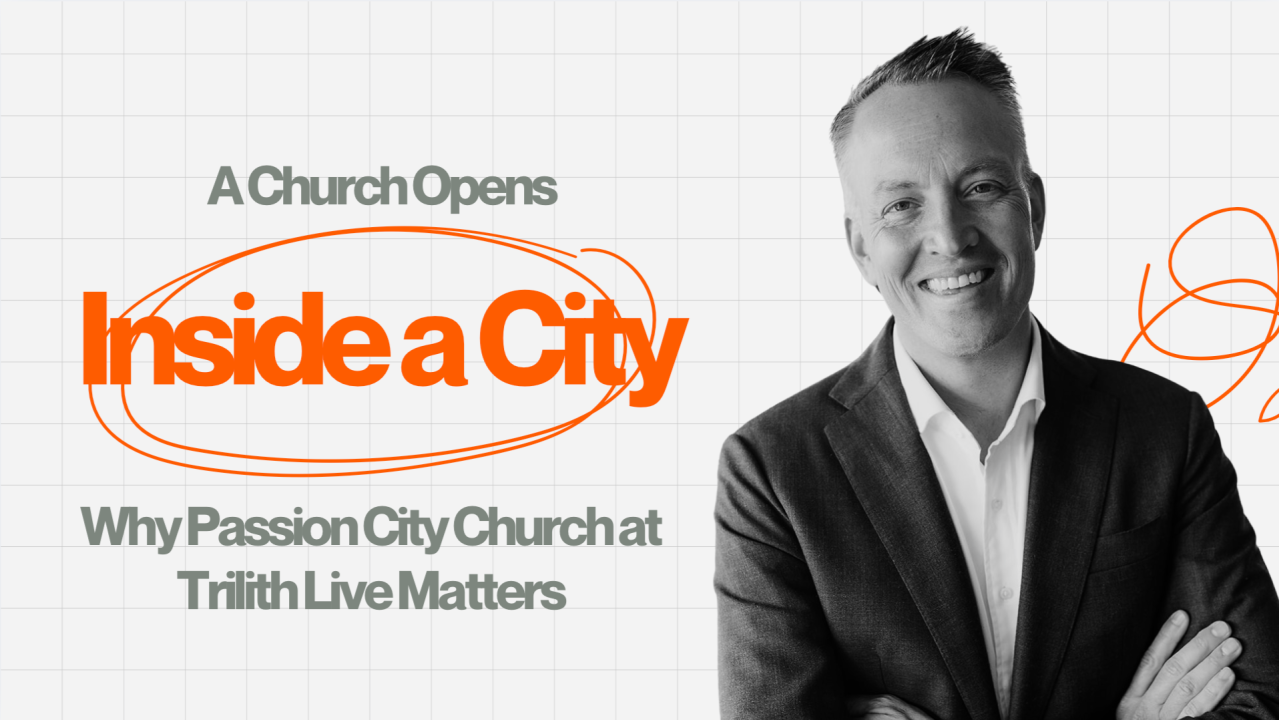
On February 1, Passion City Church opened its new home inside Trilith Live, a 530,000-square-foot entertainment and production complex in South Metro Atlanta. It's not a rented auditorium, and it's not a novelty. It's a rare, years-long partnership between a developer and a pastor to build something neither had built alone.
Inside the complex, Passion City Church holds roughly 73,000 square feet of dedicated ministry space, while parking, plazas, and the main venue are shared with concerts, film production, and community events throughout the week. It took years of planning, a trusted architect and development team, and a church willing to rethink what "our building" even means.
That's not mission drift. It's mission design, and it's exactly the kind of redevelopment more churches will need to consider as land grows scarcer and cities grow denser.
Redevelopment Isn't Mission Drift, It's Mission Design
When churches thoughtfully develop their property, adding housing, coworking space, retail, or shared venues alongside their ministry space, they don't dilute their calling. They multiply their contact points with the community.
One Atlanta-area church turned underused parking lots into a town square with restaurants, office space, and a weekly farmers market, and saw a dramatic increase in weekday foot traffic as a result. Other churches around the country have converted excess land into affordable housing or turned unused fellowship halls into coworking space for local freelancers, creating natural, ongoing bridges to their congregations.
None of this is about running a business on the side. It's about designing space so more people encounter your church in the normal course of their week.
A New Revenue Stream for the Mission You're Already Funding
Strategic redevelopment also creates something many churches desperately need: sustainable, recurring income that doesn't depend entirely on the offering plate. Done well, revenue from a redeveloped property can fund church planting, missions, and community initiatives for years, turning a static asset into an ongoing source of Kingdom impact.
This Is Exactly Why Kingdom Real Estate Partners Exists
Your church doesn't need to become a real estate developer to steward its land well, that's not your calling, and it shouldn't be. What it needs is a guide who understands both the mission and the mechanics: the zoning, the financing, the partnership structures, and the long-term strategy that turn land into legacy.
That's the work behind our Mission Property Assessment™ and our three-phase approach:
- Assess - Understand what your property actually makes possible, given your community, your calling, and the market around you.
- Strategize - Build a plan, whether that's a mixed-use redevelopment, an SPV partnership, or a phased approach, that protects your mission while unlocking your land's full potential.
- Develop - Walk the project through to completion with partners who've done this before, so the vision becomes a place your community actually experiences.
Sacred Ground Deserves a Strategy, Not Just Stewardship in Theory
Every square foot your church owns is a seed. Planted wisely, it becomes housing, gathering space, local jobs, and gospel opportunity. Left as an empty parking lot, it stays exactly what it's always been. From a single-campus redevelopment to a 530,000-square-foot shared complex like Trilith Live, the principle is the same: where and how your church builds matters.